
01
Hospital Discharge Summary
Holds primary admission reasons, surgical procedures, prior baseline vitals, and documented chronic conditions that occurred prior to SNF transfer.
- Diagnostic reports
- Lab trend sheets
A skilled nursing resident arrives with a hospital stay, a medication list, and a rounding provider who sees them for minutes. The record that explains the resident is split across three systems that do not talk to each other.
Chart.ai reads all of it. It briefs the clinician before the round and shows the MDS coordinator what the record supports before the assessment is coded. Your team decides.

Unified records. Clearer insights. Better clinical decisions.
Clinical Timeline
Hospital Discharge
Apr 12, 2025
Facility Admission
Apr 15, 2025
Lab Change
Apr 20, 2025
Clinical Note
Apr 22, 2026
MDS Review
Pending
Key Findings
New diagnosis: Possible UTI
Supported by: Urinalysis (4/20), Nursing note (4/21)
Lab value change: Low hemoglobin
Supported by: Lab results (4/18)
PDPM category: Requires review
Supported by: Discharge summary, Comorbidities

Surface relevant clinical changes and uncaptured diagnoses before the visit.
Evidence
Discharge Summary
Page 2 • Diagnosis
Lab Results
04/18 • Hemoglobin 9.2
Nursing Note
04/21 • Fatigue, decreased intake
Every finding is connected to the original documentation in the record.
Convergence Architecture
The hospital discharge summary holds the diagnoses and the comorbidities. The facility system holds the nurse shift logs and the care plan. The pharmacy holds the med list.
01
Holds primary admission reasons, surgical procedures, prior baseline vitals, and documented chronic conditions that occurred prior to SNF transfer.
02
PointClickCare or MatrixCare shifts. Contains CNA activities of daily living (ADL) records, nurse shift notes, incident reports, and immediate physician orders.
03
The active medication administration record (eMAR). Identifies active high-risk medications, recent titrations, intravenous therapies, and missed doses.
Clinical Briefing
The rounding provider gets a brief on every resident before entering the room.
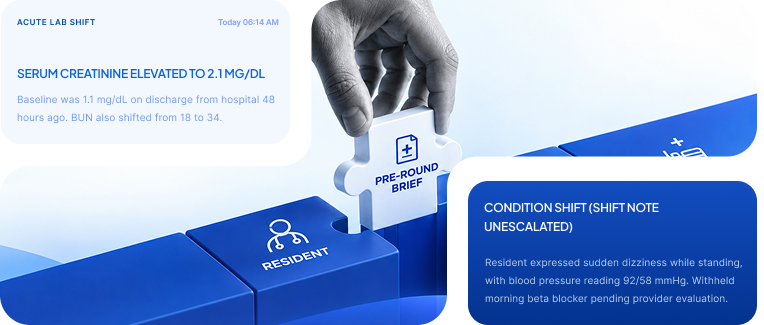
Uncaptured diagnoses with the evidence behind them. Acute lab shifts since the last visit. A change in condition between rounds that the shift notes recorded and nobody escalated.
The provider walks in already knowing what changed. The visit goes to the resident instead of to the chart.
Full provenance citation on every alert
Assessment Protocol
PDPM pays on what the record supports inside the assessment window. A condition that is not in the chart when the MDS is coded does not pay, and a condition coded without a physician behind it does not hold up on audit.
Chart.ai hands the MDS coordinator four things before the 5 day assessment is coded:
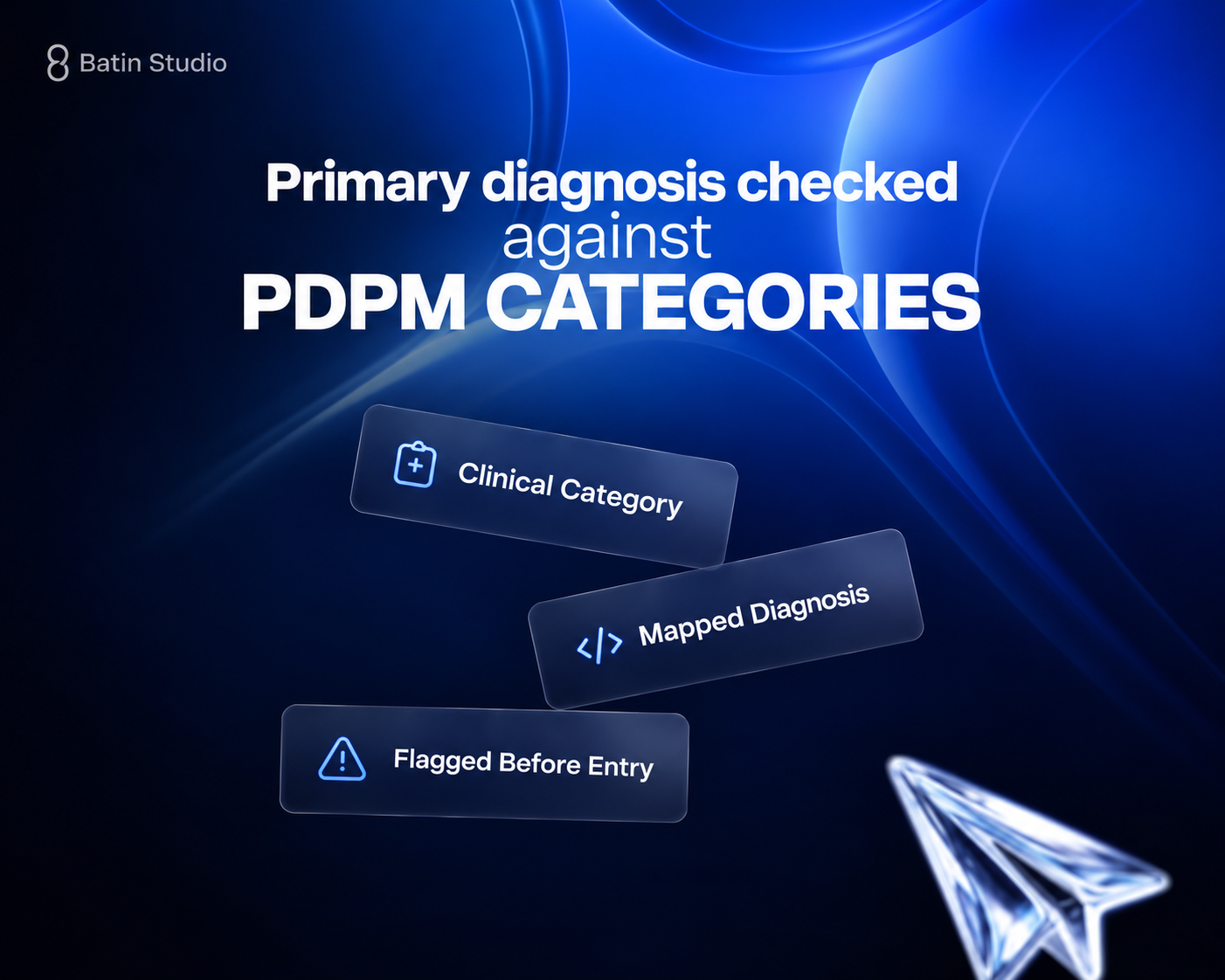
Codes that return to provider are flagged before they are entered.

A condition with evidence but no physician note in the lookback goes to the rounding provider for the next visit.
New diagnoses, new treatments and functional change picked up between assessments. An interim assessment becomes a decision, not a surprise.
Qualifying conditions in the discharge summary, labs and med list, each pointing to the line in the record behind it.
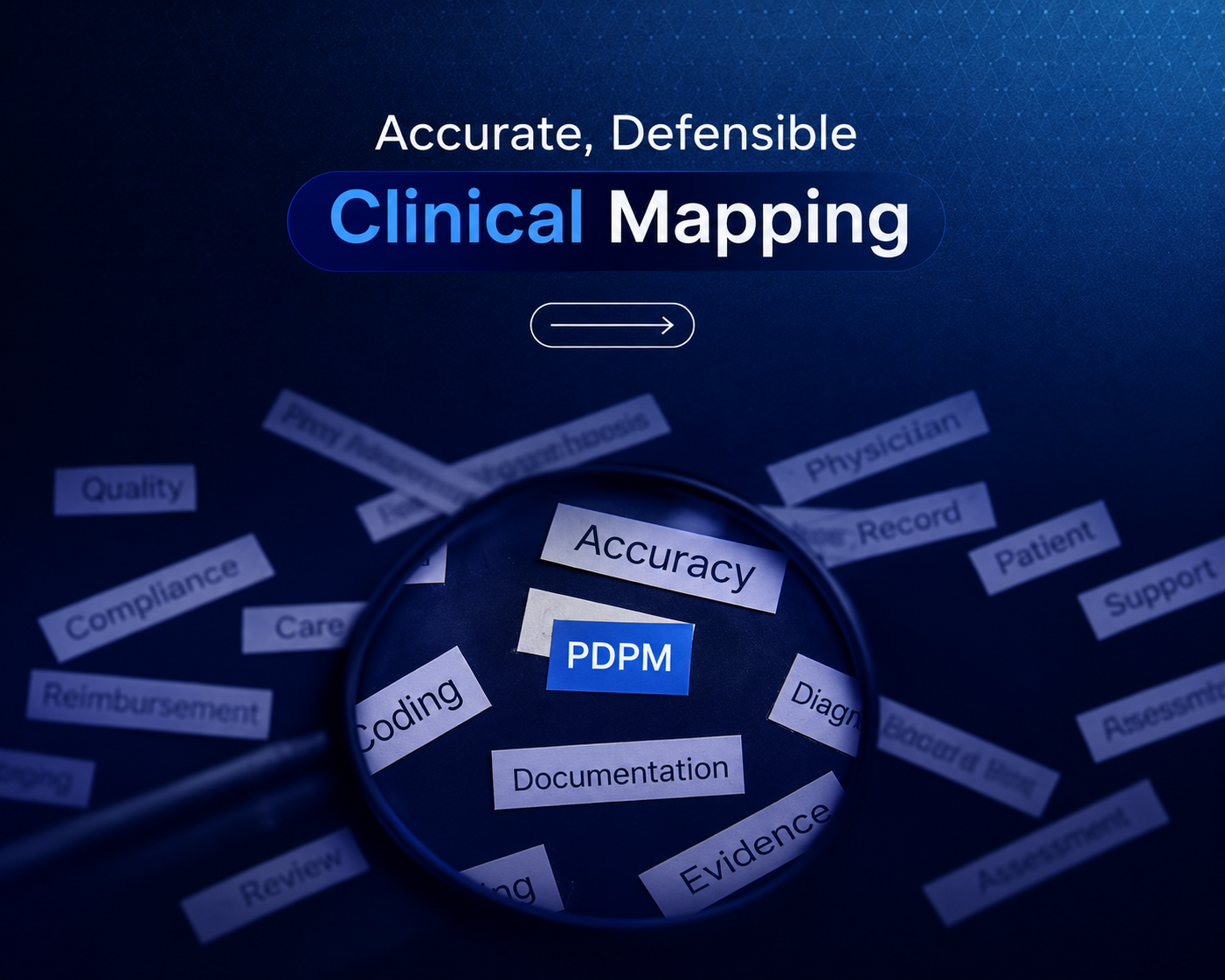
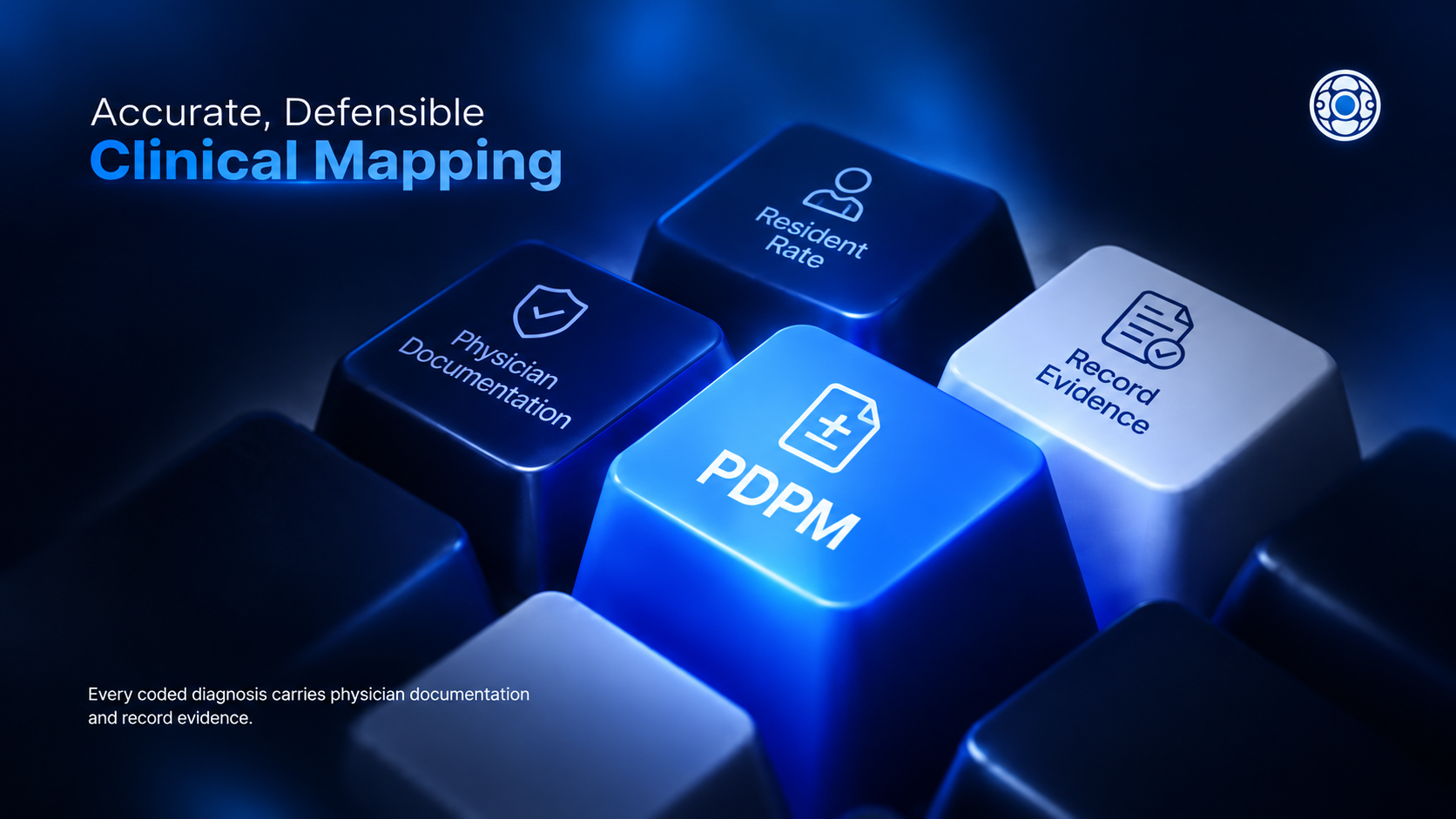
The result is accurate PDPM and defensible PDPM. The rate reflects the resident. Every coded diagnosis carries physician documentation and record evidence.
PDPM Module
The module reads the entire resident chart and shows the MDS coordinator where the chart and the MDS disagree, with the evidence behind every finding. People confirm or dismiss each item. Nothing is coded automatically.
How it works
Provider, nursing, CNA, therapy, orders, MAR, transfer packet
Reads every note, finds indicators, cites the source text
Confirms or dismisses each finding. A person decides
Neutral, one issue, chart evidence attached
By the coordinator, from confirmed documentation
Read-only. The module never writes to the EHR or the MDS, never diagnoses and never shows reimbursement figures to providers.
What the module finds
The last two matter as much as the first two. A diagnosis carried forward without current clinical support is an audit exposure, and the module flags it the same way it flags a missed condition.
Provider documentation present, active and consistent with the chart
Clinical indicators in the chart, no provider documentation
Two parts of the record disagree
Coded or documented, but no current indicators or treatment
PDPM components
Primary diagnosis and clinical category
Primary diagnosis and clinical category
SLP comorbidities, swallowing, cognition, diet orders
Clinical complexity, services, mood and cognitive screens
Comorbidities, treatments and services in the point count
Section GG and BIMS remain assessments performed by facility clinical staff. The module never suggests a score.
Timing
within 24 to 48 hours
Day 1
1 to 2 days before
Day 3
ARD set on day 5 to 8
Day 5 to Day 8
event-triggered re-review
completeness check
Discharge
within 24 to 48 hours
Day 1
1 to 2 days before
Day 3
ARD set on day 5 to 8
Day 5 to Day 8
event-triggered re-review
completeness check
Discharge
A finding surfaced after the ARD is far less useful than one surfaced on day one to three.
Provider queries
Documentation query · Resident [name] · Stay admitted [date]
Clinical indicators
Question
Based on your clinical judgment, can the clinical picture above be further clarified?
Response
Please respond using your independent clinical judgment. This query is not intended to suggest any particular response.
By design
Design decisions, not missing features. They are what make the module defensible in a survey or an audit.
Compliance principles
Unsupported findings get dismissed. Supported items do not get missed.
Every MDS item is backed by chart documentation. The module points to it.
Providers make diagnoses. Facility staff code the MDS. The module surfaces indicators only.
Every finding, edit, approval, query and response in an immutable, exportable log.
Evaluation
Shadow period
2 to 3 weeks, no action taken
Live review on new admissions + look-back on recent discharges
Short-stay Part A residents. Metrics set before data collection
Results review
Per building, never pooled
How many flags the MDS team agreed with
Items the team had before the flag
What the review adds for the coordinator
How useful the cited text is
Response rate, time and "not supported" share
One building, your own residents and staff, measured against the numbers above.
01
Hospital, facility, pharmacy.
02
Every condition, every setting.
03
The rules are Playbooks, written in plain language by certified coders and clinicians.
04
Each linked to the line in the record.
05
MDS coordinator, rounding provider, medical director.
Every admission reviewed before the 5 day assessment. Every finding cited. Nothing to install.
Zero IT FrictionWorkflow Continuity
No new software for nurses or facility teams. Operations continue in PointClickCare or MatrixCare. Paper records are read as scanned files.
The rounding clinician and the MDS coordinator receive structured intelligence in the tools they already use. Nobody logs into anything new.
Direct read-only integration preserves clinical routines.
High accuracy OCR engine absorbs physical binder pages seamlessly.
Delivered via daily round briefs and coordinator summary dashboards.
No additional passwords or separate portal credentials required.

One building or a portfolio. The same Playbook runs every resident in every building, so the standard is the same across the portfolio.

Direct to the MDS coordinator where the facility wants the assessment support on its own.

Chart.ai arrives with the rounding practice that serves the building, so the provider is briefed before every visit from the first day.
Deployment Model
Chart.ai for Skilled Nursing comes with the rounding practice that serves your building, or directly to your MDS team.
A 90 day pilot in one building, measured against your own case mix index, NTA capture rate and interim assessment count.
Get clear answers about resident documentation, clinical rounding, and PDPM assessment support with Chart.ai.
No. It reads the record and shows the coordinator what the record supports, with evidence. The coordinator codes the assessment.
Chart.ai reads from PointClickCare and MatrixCare and reports back to the team. Nurses never leave their system.
No. Chart.ai never writes to the chart on its own and never diagnoses. A person accepts or rejects every finding.
A brief on every resident before the visit. It includes uncaptured diagnoses with evidence, lab changes and any change in condition since the last round.
It is about an accurate one. Chart.ai captures what the record supports and flags what it does not. A diagnosis without physician documentation is flagged as a gap, not coded.
Before the 5 day assessment is coded, the coordinator sees the primary diagnosis checked against Patient Driven Payment Model categories. They also see the comorbidities found in the record and the physician documentation gaps, each linked to the line behind it.
Chart.ai watches the record between visits and flags a change in condition to the rounding team. The same signal can flag a resident for a possible interim payment assessment. The care team sees the decline earlier and decides what to do.
Yes. Paper records are read as scanned files. Your team keeps working the way it works today.
No. Chart.ai does not train AI on resident data, and a HIPAA business associate agreement is in place.
Both. The same Playbook runs every resident in every building, so the standard is the same across a portfolio.
Still have questions?
We're here to help you navigate the complexities of revenue cycle intelligence.


