Wound.ai
Wound Care
Validates encounter documentation and coding alignment against payer policy during the pre-billing phase, where most wound care denials are created.
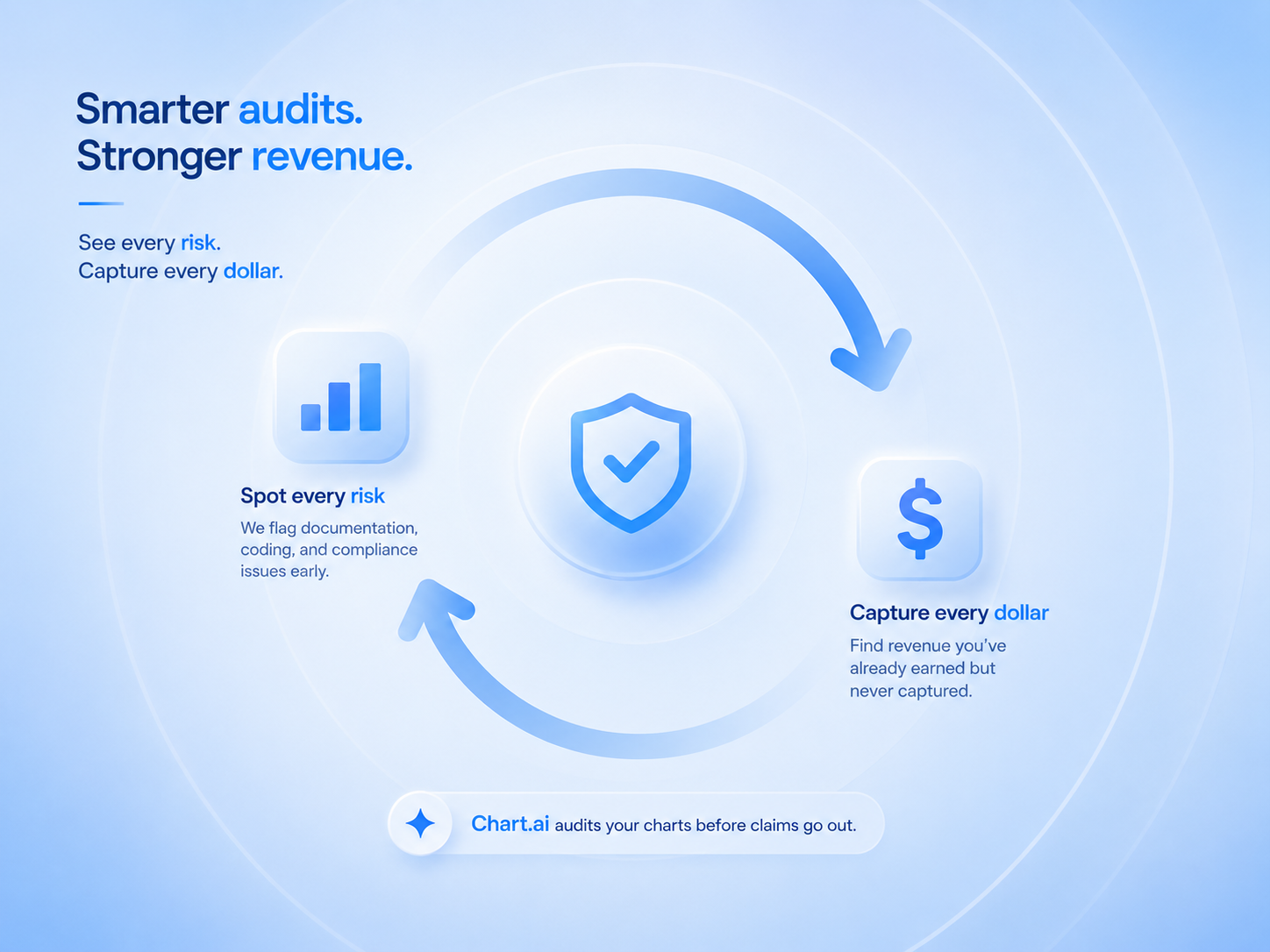
Chart.ai audits your charts before claims go out. It flags documentation, coding, and compliance risk, and it finds the revenue you already earned but never captured.

100%
of charts audited before submission
Pre-Bill
Risk and opportunity caught upstream
0 rip
Sits on top of your existing EHR
5 Apps
Specialty-tuned and growing
What is Chart.ai?
Chart.ai is Grelin's AI powered chart auditing and revenue intelligence engine. It reviews every chart for documentation gaps, coding risk, and compliance issues, and it surfaces undercoded encounters and missed billable services before a claim is ever created.
The Problem
By the time a denial lands, the mistake is weeks old. The documentation gap, the wrong modifier, the undercoded encounter. All of it was created upstream, inside the chart.
Manual auditing only samples a fraction of charts, and it happens after claims are already out the door. The charts that quietly lose money never get looked at.
Chart.ai changes where the work happens. It reads the chart first, so the problem gets fixed before the claim exists.
The Old Way
Every step after submission is rework. Chart.ai removes the steps by catching the issue at the chart.
With Chart.ai
The Engine
Chart.ai runs on top of your EHR and RCM stack. It does not replace anything. It adds the upstream visibility your team never had.
01
Reviews each chart for documentation gaps, coding risk, and compliance issues before claims are filed.
02
Identifies undercoded encounters and missed billable services that suppress reimbursement without ever triggering a denial.
03
Surfaces the charts that matter most, so your team spends expert time where the revenue impact is highest.
04
Accuracy improves over time by learning from outcomes across your practices and specialties.
05
Integrates with your existing EHRs and workflows. No system replacement, no workflow disruption.
06
Delivers CFO-ready insight into where revenue is leaking, why it happens, and how to fix it upstream.
Specialty Applications
Every specialty has its own documentation standards, modifiers, and payer logic. Chart.ai powers a family of applications built for the exact rules that decide reimbursement in each modality. Each one is powered by Grelin.
Wound Care
Validates encounter documentation and coding alignment against payer policy during the pre-billing phase, where most wound care denials are created.
Pain Management
Validates authorization requirements, documentation alignment, and coding consistency against payer policy before claims enter the billing workflow.
Durable Medical Equipment
Analyzes documentation, physician notes, and billing data against thousands of DME payer rules and modifier requirements before claims are submitted.
Evaluation & Management
Analyzes physician documentation in real time to flag missing elements needed to support the appropriate E/M level, reducing undercoding across hospital systems.
Behavioral Health
Checks medical necessity, time-based and session coding, authorization, and documentation against behavioral health payer requirements before claims go out.
Chart.ai's architecture scales to new specialties. Tell us where your revenue is leaking and we will map the chart logic.
Talk to usThe same engine extends to new modalities without diluting the platform. Each new application is tuned to its own documentation and coding rules.
How it works
STEP 1
Chart.ai connects to your existing EHR. No data migration, no system replacement.
STEP 2
Every chart is analyzed before submission for documentation, coding, and compliance risk, and for missed revenue.
STEP 3
The risk engine ranks charts so your team works the highest-impact items first.
STEP 4
Issues are fixed upstream. Claims go out clean, and earned revenue gets captured.
Proof
$4.5M+
Combined annual revenue uplift and cost savings at a multi-location wound care program using Wound.ai.
96–98%
First-pass claim acceptance at a regional pain management group using Pain.ai.
30%
Reduction in billing rework after moving authorization and coding checks upstream.
“Grelin changed how we think about RCM. We are no longer chasing denials, we are preventing them. The financial impact showed up faster than we expected, and our teams finally feel ahead instead of behind.”
Support Center
Find answers about Chart.ai, clinical documentation, medical coding, specialty-specific documentation, and Claim Integrity.
Chart.ai turns clinical documentation into complete, defensible claims. It reads the chart, checks whether the documentation supports the intended codes, and flags gaps before the claim is created. The claim that comes out matches the care that was documented.
Because the claim is only as defensible as the chart behind it. A correctly coded claim with incomplete documentation fails on audit. Chart.ai checks the documentation at the point it is written, when the clinician can still fix it in seconds.
Wound.ai is the Chart.ai module for wound care. Wound care claims carry documentation requirements that generic checks miss, including wound measurements, staging, and treatment rationale over time. Wound.ai validates that the chart meets those requirements before the claim is built.
Pain.ai is the Chart.ai module for pain management practices. Pain management billing carries heavy payer scrutiny around medical necessity and procedure documentation. Pain.ai checks the chart against those requirements before submission, so claims hold up when they are questioned.
Behavioral.ai is the Chart.ai module for behavioral health and addiction treatment facilities. These claims fail on authorization tracking, level-of-care documentation, and payer-specific coverage rules. Behavioral.ai validates against those requirements before the claim leaves the facility.
Because payer rules and documentation standards differ by specialty. What makes a wound care claim defensible is different from what makes a behavioral health claim defensible. General checks catch general errors. The expensive failures live in the specialty-specific logic.
Still have questions?
We're here to help you navigate the complexities of revenue cycle intelligence.
Bring a sample of charts. We will show you the risk and the revenue hiding inside them before a single claim goes out.